
Overview
In this SEO case study, you’ll learn how we increased a website’s monthly organic traffic from 1,600 to over 40,000 visitors in just six months using technical SEO, content optimization, authority building, and a sustainable growth strategy.
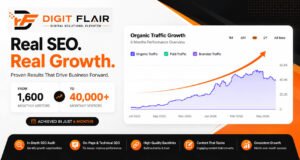
When this project came to us, the website was receiving approximately 1,600 monthly organic visitors.
At first glance, the website looked functional. The design was decent, content existed, and the business had already invested time and effort into building its online presence.
However, organic growth had stalled.
Despite having content and indexed pages, the website was not generating the level of visibility, traffic, or business opportunities it should have been.
Our objective was not simply to increase traffic numbers. The goal was to build a stronger SEO foundation that could generate sustainable organic growth over the long term.
What We Found During the Initial Audit
Before making any changes, we conducted a detailed website audit.
Several issues became immediately visible:
- Internal linking was inconsistent across important pages.
- Some conversion-focused CTAs were missing or not functioning properly.
- Mobile user experience needed improvement.
- Technical SEO issues were affecting crawling and indexing efficiency.
- Previous design changes had negatively impacted page speed.
- Content publishing was inconsistent.
- The website lacked a structured authority-building strategy.
Individually, these issues may not seem critical.
Combined, they were limiting the website’s ability to compete in search results.
Phase 1: Fixing the Foundation
One of the biggest mistakes businesses make is jumping directly into backlinks and content creation without fixing underlying website issues.
We took the opposite approach.
The first phase focused on strengthening the foundation.
Website Structure & User Experience
We reviewed how visitors interacted with the website and identified areas where navigation and user flow could be improved.
Key improvements included:
- Better page hierarchy
- Improved mobile responsiveness
- Clearer navigation paths
- Strategic call-to-action placement
- Enhanced user journey across key landing pages
The objective was simple:
Make it easier for both users and search engines to understand the website.
Phase 2: On-Page SEO Optimization
Once the website structure was improved, we focused on on-page optimization.
This included:
- Internal linking improvements
- Metadata optimization
- Content structure refinement
- Keyword alignment with search intent
- Better page-level relevance signals
Rather than targeting keywords blindly, we focused on matching content with what users were actually searching for.
This helped improve both relevance and user engagement.
Phase 3: Technical SEO Improvements
Technical SEO played a significant role in this project’s success.
We addressed several issues affecting overall performance, including:
- Page speed optimization
- Crawlability improvements
- Indexing inefficiencies
- Technical errors affecting search visibility
- Site performance enhancements
These improvements helped search engines access and process the website more efficiently.
Phase 4: Building Authority
After strengthening the website itself, we focused on authority building.
This involved:
- Acquiring high-quality backlinks
- Building relevant citations
- Improving trust signals
- Expanding the website’s topical authority
Authority building was approached gradually and strategically rather than aggressively.
The focus remained on quality over quantity.
Phase 5: Consistent Content Publishing
Content became the growth engine behind the campaign.
We started publishing content consistently across multiple formats, including:
- Blog articles
- Industry-focused educational content
- Testimonials
- Informational resources
- Business-focused updates
Each piece of content was created with a specific search intent and audience need in mind.
Over time, this helped expand the website’s topical coverage and organic visibility.
When Results Started Appearing
One of the most important lessons from this project is that SEO rarely produces immediate results.
For the first two to three months, growth was relatively modest.
This is often the stage where many businesses become impatient and abandon their strategy.
However, we continued improving the website, publishing content, and building authority.
As search engines processed the changes and user engagement improved, rankings started moving upward.
The growth then began to compound.
Results Achieved
Within approximately six months, the website experienced significant organic growth.
Key Outcomes
- Organic Traffic Growth: 1,600 to 40,000+ Monthly Visitors
- Improved keyword visibility across multiple search terms
- Stronger website authority
- Better user engagement metrics
- Increased organic reach
- Sustainable long-term growth trajectory
The traffic increase was not the result of a single tactic.
It was the outcome of multiple SEO disciplines working together.
Key Takeaways
This project reinforced several important SEO principles:
- Technical SEO matters.
- User experience impacts search performance.
- Content works best when aligned with search intent.
- Authority building requires consistency.
- Sustainable SEO growth is built over time, not overnight.
The most successful SEO campaigns are rarely based on shortcuts.
They are built on a strong foundation, consistent execution, and a clear understanding of user needs.
Looking to Improve Your Organic Growth?
Every website faces different challenges, but the underlying principles remain the same.
If your website is struggling with rankings, traffic, or visibility, a structured SEO strategy can help uncover growth opportunities and build sustainable long-term results.
At Digit Flair, we help businesses improve their online visibility through SEO, website optimization, local SEO, and content-driven growth strategies.
Contact us for a free SEO consultation and website audit.